June 3, 2026
What Is Evolutionary Tarot? The Complete Guide
Evolutionary tarot is a tool for introspection and self-knowledge based on Jungian psychology. Discover what sets it apart from divination tarot and how it can support your personal growth.
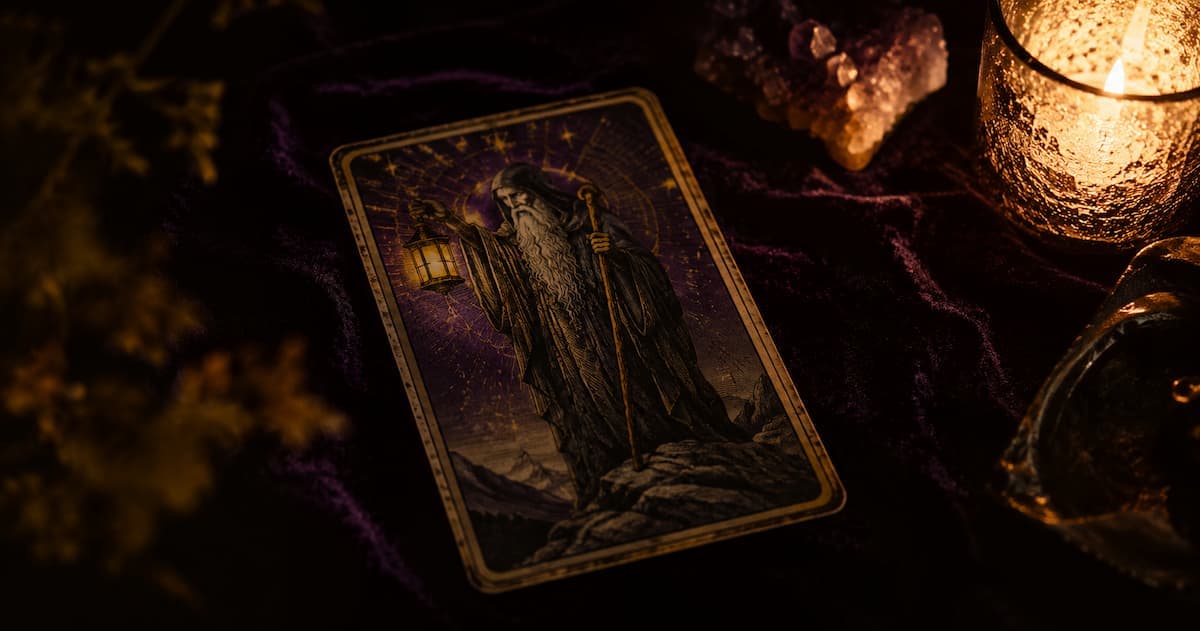
Evolutionary tarot is an approach to tarot that uses the 78 cards as a tool for introspection and self-knowledge — not as a method of prediction. Instead of asking "what is going to happen to me?", evolutionary tarot asks "what part of me needs attention right now?". It is tarot in service of personal growth.
That distinction may seem subtle, but it completely transforms your relationship with the cards — and with yourself.
What Is Evolutionary Tarot?
Evolutionary tarot — also called therapeutic tarot or psychological tarot — is a current within tarot practice that places self-knowledge at its center. Its roots lie in Jungian psychology: Carl Jung recognized in the archetypes of tarot a symbolic system that reflects the universal patterns of the collective unconscious.
From this perspective, each Major Arcana is an archetype — a universal figure representing an inner state, a psychic energy, or a process of transformation. The Fool does not predict a journey; it embodies the impulse to venture into the unknown. The Tower does not announce catastrophe; it symbolizes the necessary collapse of structures that no longer serve.
Evolutionary tarot does not try to reveal the future. It tries to illuminate the present.
Evolutionary Tarot vs. Divination Tarot
| Traditional / Divination Tarot | Evolutionary Tarot | |
|---|---|---|
| Central question | What is going to happen to me? | What do I need to see right now? |
| Role of the reader | Mediator with the hidden | Facilitator of introspection |
| The cards are... | Messages from destiny | Archetypes of the unconscious |
| The future is... | Predictable and fixed | Open and shapeable |
| The power lies in... | The cards | The person |
The most important difference is where the power resides. In divination tarot, the cards know something you do not. In evolutionary tarot, the cards reflect something you already know but may not yet have seen clearly.
The Psychological Foundations of Evolutionary Tarot
Jungian Psychology and Archetypes
Carl Jung devoted a significant part of his work to studying humanity's symbolic systems — mythology, alchemy, dreams, and tarot among them. For Jung, these systems were not superstition but maps of the collective unconscious: universal patterns shared by all of humanity. In The Archetypes and the Collective Unconscious (1959), Jung described these universal patterns as inherited predispositions that shape how humans experience and respond to the world — independent of culture or era.
The 22 Major Arcana of tarot map precisely onto these Jungian archetypes. The Magician represents conscious will and the ability to manifest. The High Priestess embodies intuitive knowledge and the mysteries of the unconscious. The Hermit symbolizes the wisdom found only in solitude and introspection.
Jungian analyst Sallie Nichols explored this connection in depth in Jung and Tarot: An Archetypal Journey (1980), one of the most influential works on the psychological interpretation of tarot cards.
When you draw a card, you are not receiving an external message. You are activating an internal resonance — something in you recognizes that archetype because it lives within you.
Synchronicity as a Framework
Jung also developed the concept of synchronicity — the meaningful coincidence between an external event and an inner state. From this perspective, the card that appears in a reading is not random in the sense of being meaningless. It is meaningful because it resonates with what is alive in you at that moment.
It is not magic. It is depth psychology.
What Evolutionary Tarot Is Good For
Evolutionary tarot is especially useful in these contexts:
Clarity in moments of decision — when you have too many options or have been turning a question over in your mind for too long, a reading can help you identify what you truly value and what you fear.
Exploring repetitive patterns — if you keep finding yourself in the same situations over and over, tarot can help you see the pattern from the outside and understand which part of you is creating it.
Support through periods of change — life transitions — a career change, the end of a relationship, a relocation — activate many archetypes at once. Evolutionary tarot helps you name them and work with them consciously.
Mindfulness practice — a well-approached tarot reading requires you to stop, breathe, and honestly ask yourself how you are doing. That moment of pause has value in itself.
How to Do an Evolutionary Tarot Reading
The difference between an evolutionary tarot reading and a divination reading is not in the cards — it is in the questions and the attitude you bring.
Questions that open (evolutionary tarot):
- What part of me needs attention right now?
- What am I avoiding seeing in this situation?
- What is this moment asking of me?
- What strength do I have that I am not using?
Questions that close (predictive tarot):
- Will my ex come back?
- Will I get the job?
- When will I find a partner?
The 3-card spread is perfect for beginners: the first card speaks to the current situation, the second to the core or root of the matter, and the third to the path forward or advice. It is not past-present-future — it is progressive depth.
Evolutionary Tarot and Psychological Therapy
To be clear: evolutionary tarot is not therapy and does not replace working with a mental health professional. However, it can be a valuable complement for people already engaged in a therapeutic or personal growth process.
Many therapists and coaches use similar projective tools — images, metaphors, figures — precisely because symbolic language accesses layers of experience that rational language does not always reach. Evolutionary tarot works in a similar way.
If you are going through a significant emotional crisis, seek professional support. Tarot can accompany that process — not replace it.
Frequently Asked Questions About Evolutionary Tarot
Do you have to believe in tarot for it to work?
No. Evolutionary tarot requires no supernatural belief. It only requires honesty with yourself and a willingness to reflect. The cards are a symbol system — their value lies in what they activate in you, not in any external power.
How is evolutionary tarot different from traditional tarot?
Traditional tarot seeks answers about the future. Evolutionary tarot seeks understanding of the present. The first places the power in the cards; the second places the power in the person.
Is evolutionary tarot the same as therapeutic tarot?
The terms are used interchangeably. "Therapeutic tarot" emphasizes its use as a complement in personal growth processes. "Evolutionary tarot" emphasizes the idea that tarot accompanies personal evolution. The foundation is the same.
Which deck is best for evolutionary tarot?
The Rider-Waite Tarot is the most widely used because its imagery is rich in Jungian symbolism and the most thoroughly studied. Any deck with detailed symbolic imagery works well, however.
Can I do evolutionary tarot without knowing how to read tarot?
Yes. You can start simply by looking at the card that appears and asking yourself: what does this image evoke in me? What part of my current life do I recognize in it? You do not need to memorize meanings — personal resonance is enough to begin.
Further Reading
- Carl G. Jung — The Archetypes and the Collective Unconscious (1959)
- Sallie Nichols — Jung and Tarot: An Archetypal Journey (1980)
- Carl G. Jung — Man and His Symbols (1964)
- Jungian archetypes — Wikipedia
- Tarot — Wikipedia
Want a more personal perspective? I wrote about the reading that first showed me tarot could be something deeper than fortune-telling — and how that led to building AuraCosmus. You can read it on Medium.
At AuraCosmus we practice evolutionary tarot as a free and accessible tool for self-knowledge. You can do a free tarot reading right now, no registration required.
✦ You might also like ✦